The Age of Reptiles: Dinosaurs in Geologic Time
from The Age of Reptiles: Its Antiquity, Duration, and Significance in Geologic History by W.D. Matthew
Paleontology reveals the history of life measured not in centuries but in geologic epochs spanning millions of years. Humanity, with its mere forty centuries of civilization, appears as a creature of yesterday—a fleeting episode amid vast temporal expanses. Adjusting our perspective to these immense scales proves challenging; we often misconstrue all extinct beasts as “prehistoric,” imagining dinosaurs coexisting with cave-dwelling ancestors in a single chaotic era. To grasp the dinosaurs’ true place, one must comprehend the profound separations between geologic periods, where faunas rose and vanished across eons.
The Age of Man aligns with the Pleistocene epoch of the Quaternary period, geology’s shortest span. Prehistoric savages roamed before written records, amid mammoths, mastodons, megatheria, and Irish elk—many now extinct, yet most fauna resembling modern species. This era featured the Ice Age, blanketing vast lands in ice sheets whose remnants persist in Greenland and Antarctica. Preceding it lay the Tertiary or Age of Mammals, thirty times longer, tracing quadrupeds’ evolution from primitive ancestors into horses, camels, elephants, and rhinoceroses, alongside vanished titanotheres and oreodonts. Primitive primates hinted at man’s collateral lineage, though no true humans existed.
The Age of Reptiles, or Mesozoic Era, preceded this—a panorama of reptilian dominance evoking an alien world. No familiar quadrupeds roamed; instead, reptiles filled every niche: carnivorous and herbivorous, terrestrial, aquatic, and aerial. Swamp-dwelling crocodiles and turtles mirrored modern kin, while sea-crocodiles, flippered mosasaurs, and long-necked plesiosaurs supplanted today’s whales and seals. Bat-winged pterosaurs partially echoed birds,their membranes stretched on elongated fingers, though enigmatic and poorly reconstructed. Fishes and invertebrates diverged from contemporaries—ammonites abounded like pearly nautiluses, brachiopods lingered sparingly, and early insects lacked butterflies, bees, or ants, featuring dragonflies and beetles until flowering plants spurred higher orders.
Vegetation shifted dramatically: early Mesozoic cycads, ferns, conifers akin to Norfolk pines, ginkgos, and giant horsetails evoked coal-forest gloom, sans deciduous trees. Later, angiosperms proliferated, displacing primitives (many surviving tropically) and fueling Cenozoic life’s ascent via nutritious fruits. Land reptiles centered on dinosaurs—short-bodied, long-tailed, long-legged walkers or runners, often bipedal like ostriches, balancing via tails. Ranging cat-sized to gigantic, they mirrored modern quadrupeds’ diversity: theropods (carnivores like Allosaurus, Tyrannosaurus) with serrated teeth and claws; sauropods (amphibious giants like Brontosaurus, Diplodocus) boasting giraffe-necks, elephant-limbs, weighing tons; ornithischians (beaked herbivores) including iguanodonts, duckbills, plated stegosaurs, horned ceratopsians.
North America during this era transformed ceaselessly: erosion leveled mountains, rivers deposited sediments into shallow seas, volcanic upheavals rebuilt; isostatic rebound from sediment loads triggered subsidences and emergences. Periods began and ended in uplift, fostering cold poles and arid interiors; submergences brought uniform warmth. The Cretaceous saw maximal flooding—plains from Gulf to Arctic submerged—yielding delta fossils preserving dinosaurs like late-Jurassic Allosaurus preying on Brontosaurus (evidenced by bite-marked bones, shed teeth). Upland records eroded away, leaving “snapshots” of coastal-swamp faunas, imperfect yet vivid. Dinosaurs reigned nine million years—thrice post-extinction time—succumbing to climatic shifts, mammalian/bird ascendancy.
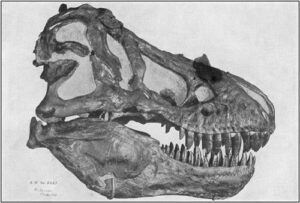
Carnivores like 34-foot Allosaurus and 47-foot Tyrannosaurus embodied reptilian ferocity: bipedal, bird-proportioned, scaly-skinned (sans armor), brains inferior to crocodiles, instincts driving ambush rushes sans mammalian cunning. Herbivorous sauropods, amphibious swamp-dwellers, gulped soft plants unchewed, their light necks/heads atop massive bodies buoyed by water against joint strain. Preparation of museum mounts—excavating Wyoming quarries, piecing shattered fossils, modeling gaps via muscle studies—demanded years, yielding tableaux of Jurassic savagery. These titans, instinctive automatons, highlight evolution’s whims: reptilian giants yielded to intelligent mammals. True progress lies not in size, but adaptive intellect enduring geologic cycles.