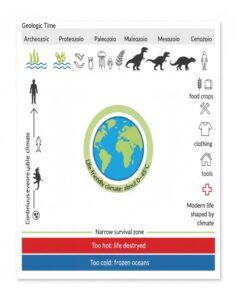
Climate shapes nearly every aspect of human and natural life, so its role today offers a powerful clue to its importance in the past and future. Food supply, clothing styles, building design, patterns of work and recreation, and even levels of health and energy all fluctuate with changes in temperature, humidity, and seasonal rhythm. Because plants and animals lack the full range of technological protections available to humans, their dependence on climate is even more direct, and their distribution across the planet mirrors the limits within which they can survive. Each species, from microscopic organisms to humans, thrives only within a relatively narrow range of temperature and moisture, and any major departure from that range leads to stress, reduced reproduction, and eventually extinction.
This tight connection between life and climate today suggests that climate must always have been a central factor in the history of the Earth. If every species has specific climatic requirements, then the long, continuous story of evolution implies that the global environment has stayed within certain bounds for hundreds of millions of years. The geological record confirms this idea by showing no absolute break in the sequence of life forms, no interval in which higher organisms abruptly vanish for ages before reappearing. Instead, fossils preserve an unbroken progression from simple unicellular life to complex plants and animals, indicating that conditions never strayed so far from the present as to sterilize the planet.
Evidence from the Archeozoic and Proterozoic eras illustrates how early the climate became suitable for life. Rocks of these ancient ages record thick layers of limestone, carbon-rich shales, and iron ores, all of which point to abundant water, carbon dioxide, and active biological processes. Even though the earliest fossils are scarce and often ambiguous, there are signs of algae, sponges, and later more complex invertebrates such as worms and trilobites in rocks hundreds of millions of years old. Since many of these organisms resemble modern forms in structure and presumed physiology, they almost certainly required temperature and chemical conditions not drastically different from those in today’s oceans.
At the same time, the fossil record reveals that climate has not been perfectly static. Geological history contains multiple ice ages and warmer intervals, as well as a general tendency toward greater climatic complexity in more recent times. In early eras the planet seems to have experienced relatively uniform conditions from equator to pole and from season to season, whereas during and after the Miocene, contrasts between regions and seasons grew more pronounced. This increasing diversity of climate created a wider variety of habitats and selective pressures, which helped accelerate organic evolution by encouraging species to adapt, migrate, or give rise to new forms.
Despite these shifts, physical and biological arguments show that the average surface temperature of the Earth has remained within surprisingly narrow limits. Most higher plants and animals cannot live for long where average temperatures exceed roughly 45°C or where oceans would be permanently frozen. If global temperatures had risen much more than about 20–30°C above present levels, the warmest seas would have become lethal to complex marine life; if they had fallen much more than 20–30°C below, ice would likely have locked the oceans, halting most biological activity. Because higher organisms never disappear completely from the record, it is reasonable to conclude that the planet has remained within this limited thermal window throughout geologic time.
Viewed on a cosmic scale, this climatic stability is extraordinary. Temperatures in the universe range from the near-absolute zero of empty space to the tens of thousands of degrees in stellar interiors, and even within our solar system the possible surface temperatures of planets span hundreds of degrees above and below those on Earth. Against this enormous backdrop, the Earth occupies a band of perhaps only a few tens of degrees centered around the freezing point of water and the conditions under which carbon dioxide dissolves readily in oceans and participates in the carbon cycle. The fact that our planet has remained in this fragile band for hundreds of millions, perhaps billions, of years has allowed life not only to arise but also to evolve steadily from simple microbes to complex, reasoning beings whose own activities now influence climate in return.